
License Keys
This guide walks you through how to use License Keys to issue cryptographically signed tokens that your application can verify at runtime to enforce usage limits, seat counts, feature flags, or any other constraint you define.
What license keys are for
Section titled “What license keys are for”License Keys are different from Application Entitlements and Artifact Entitlements. Entitlements control what a customer can access within Distr. License keys carry arbitrary data (seat counts, plan tier, feature flags) that your application reads and enforces independently of Distr.
When you request a token for a license key, Distr generates a signed JWT. Your application verifies it using the public key you generate and distribute. No call back to Distr is needed at verification time, which means license key validation works in air-gapped and offline environments.
Creating a license key
Section titled “Creating a license key”- Navigate to Licenses in the sidebar
- Click the customer you want to create a license key for
- Select the License Keys tab and click “Create License Key”
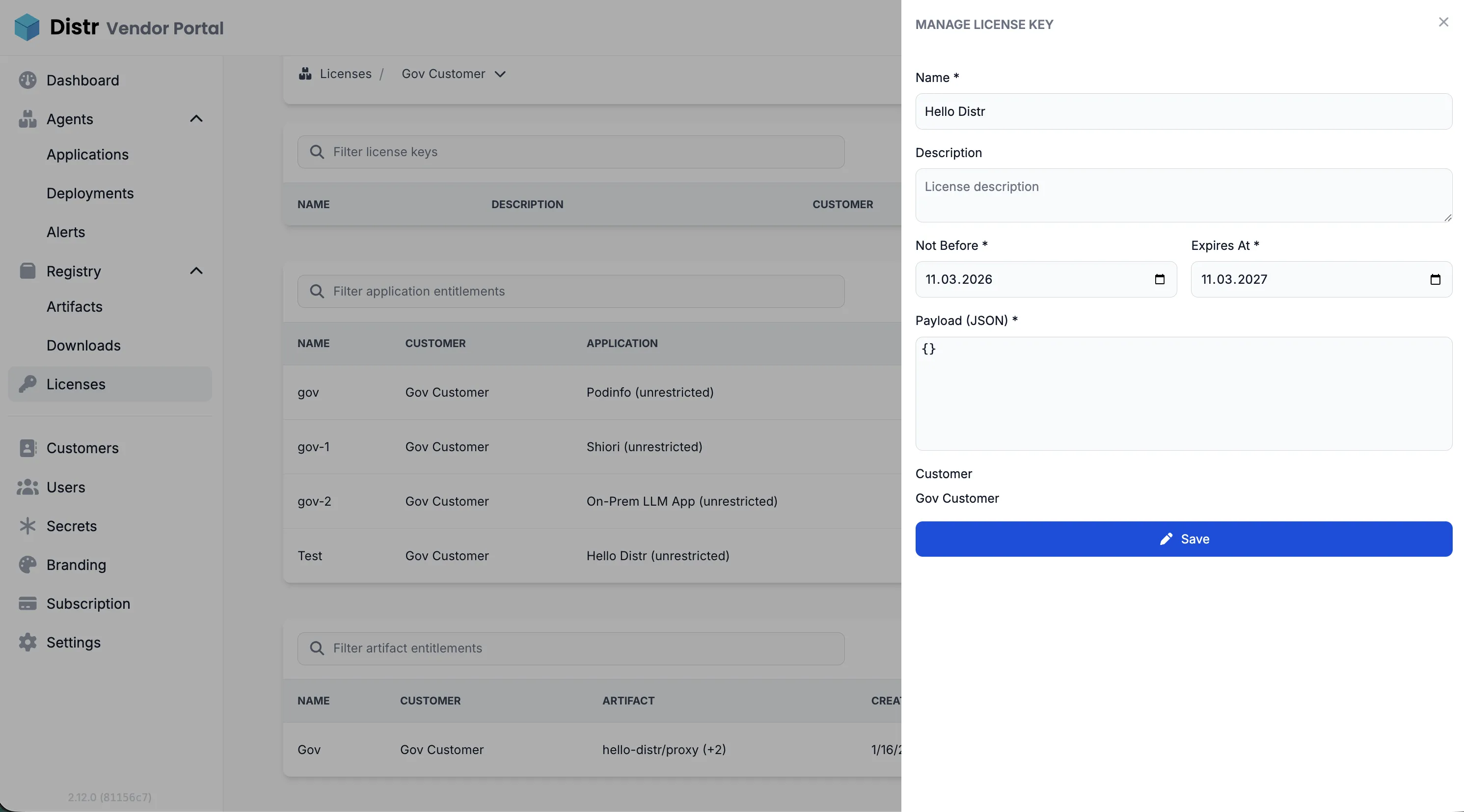
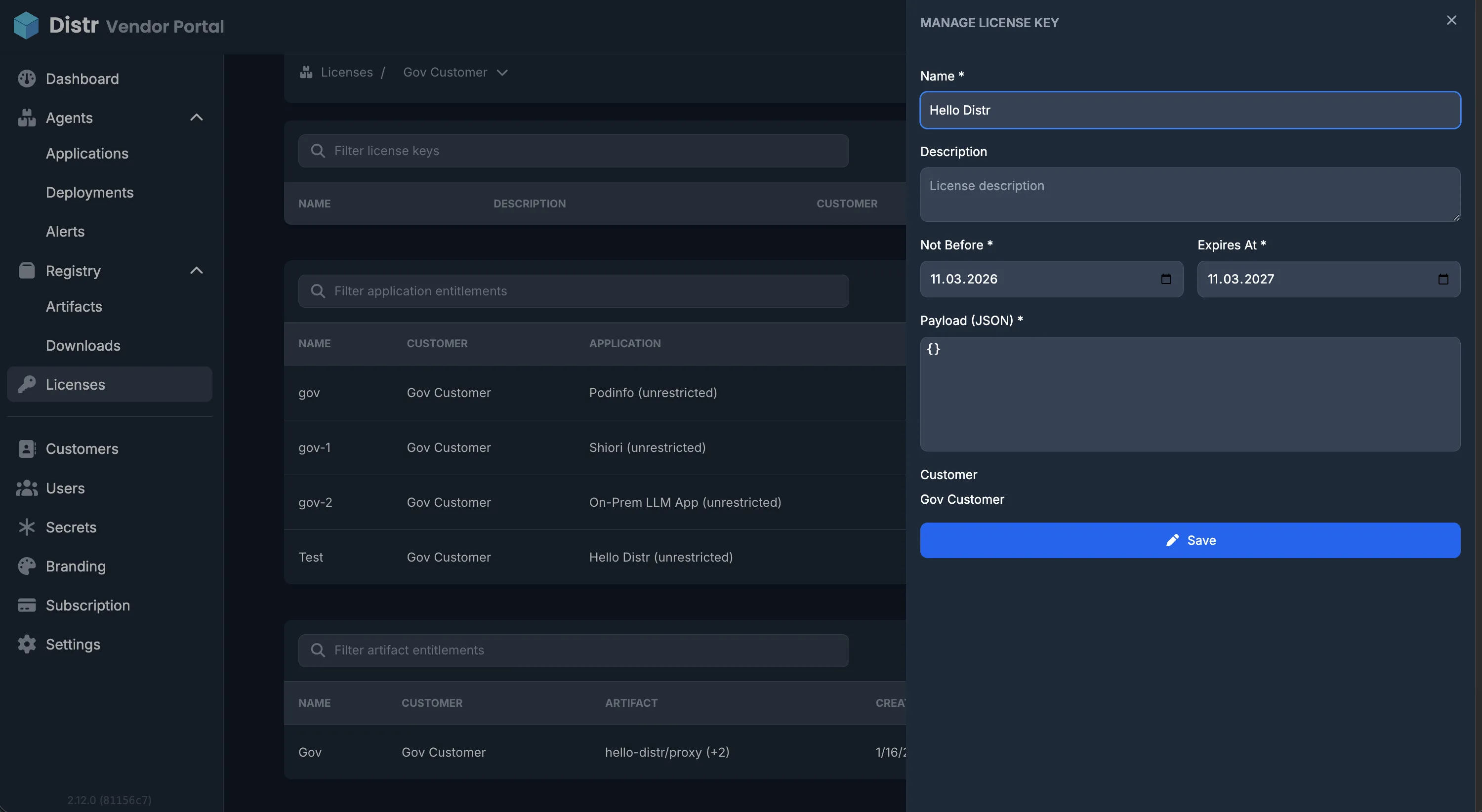
- Fill in the form:
- Name (required): must be unique within your organization
- Description (optional)
- Not Before: the date from which the token is valid (defaults to today)
- Expires At: the date the token expires (defaults to one year from today)
- Payload: a JSON object with your custom claims (see Payload below)
- Save: the key is created immediately
Payload
Section titled “Payload”The payload is a JSON object containing the custom claims you want to embed in the token. You define what these mean. Distr treats them as opaque data.
Example payloads:
{"seats": 25, "plan": "pro"}{ "instances": 3, "modules": ["analytics", "reporting"], "expires_notice_days": 30}The payload must be a JSON object (not an array or primitive). The following field names are reserved and cannot be used: the JWT-standard claims exp, nbf, iss, sub, aud, iat, as well as the Distr-specific claim org.
Getting the token
Section titled “Getting the token”Once a license key exists, you can retrieve the signed JWT at any time:
Vendor: Open the license key from the customer’s detail view and click the view (eye) icon. Distr generates the token and displays it, so you can copy it to deliver to your customer.
Customer: In the customer portal, navigate to Licenses and click the key. The token is available there directly. Customers can copy and use it in their environment.
Verifying tokens in your application
Section titled “Verifying tokens in your application”The token is a standard JWT signed with EdDSA (Ed25519). Use any JWT library that supports EdDSA to verify it.
The token contains:
iss: your Distr host URLsub: the license key UUIDaud:["license-key"]iat: issued at (when the key was created in Distr)nbf: not beforeexp: expirationorg: the UUID of your Distr organization that issued the license key- All fields from your payload as top-level claims
Retrieving the public key
Section titled “Retrieving the public key”Your application needs the public key to verify license tokens. Distr exposes it via a public API endpoint that requires no authentication:
GET /api/public/v1/license-keys/public-keyThe response is the PEM-encoded Ed25519 public key as plain text. This endpoint is available to anyone, so your application can fetch it at startup or embed it at build time.
Example (curl):
curl https://your-distr.example.com/api/public/v1/license-keys/public-keyExample verification
Section titled “Example verification”Node.js with jose:
import {importSPKI, jwtVerify} from 'jose';
const publicKey = await importSPKI(PUBLIC_KEY_PEM, 'EdDSA');
const {payload} = await jwtVerify(token, publicKey, {  audience: 'license-key',});
console.log(payload.seats); // your custom claim
Your application is responsible for deciding what to do when verification fails or the token is expired.
Editing a license key
Section titled “Editing a license key”You can update the description of an existing license key at any time. The name is set at creation and cannot be changed.
If you need to change the payload, Not Before, or Expires At, Distr generates a new license key with the updated values; the original is not modified. You can view all previously generated license keys in the Revisions section of the edit view.
If any active deployments reference this license key, Distr will show you which deployment targets are affected before saving. Confirming will save the new revision and automatically trigger a redeployment on those targets.
To edit: open the license key from the customer’s detail view and click the edit (pen) icon.
Deleting a license key
Section titled “Deleting a license key”To delete: open the license key and click the delete (trash) icon, then confirm.
Referencing license keys in deployments
Section titled “Referencing license keys in deployments”When you deploy via Distr agents (Docker or Kubernetes), license keys assigned to the customer are automatically available as template variables in deployment environment files and Helm values. You don’t need to copy or distribute tokens manually. Distr generates and injects them at deploy time.
Finding the reference syntax
Section titled “Finding the reference syntax”Each license key has a Reference column in the license keys list that shows the exact template variable to use: {{ .LicenseKeys.MY_LICENSE_KEY }}
Copy this reference directly from the UI and paste it into your deployment configuration.
Docker (env file)
Section titled “Docker (env file)”Reference a license key in the deployment’s environment file using Go template syntax:
LICENSE_TOKEN={{ .LicenseKeys.MY_LICENSE_KEY }}In the application’s Compose file, read the environment variable as usual:
services: app: image: your-app:latest environment: - LICENSE_TOKENThe token is resolved at deploy time. The application reads process.env.LICENSE_TOKEN (or the equivalent in your language) at startup and verifies it.
Helm (values YAML)
Section titled “Helm (values YAML)”Reference a license key in the deployment’s Helm values:
app: licenseToken: {{.LicenseKeys.MY_LICENSE_KEY}}The resolved token is passed into the chart at deploy time.
Registry-only deployments
Section titled “Registry-only deployments”For customers who pull artifacts directly from your Distr registry without using deployment agents, provide them with the token out-of-band. The customer is responsible for injecting it into their own deployment pipeline, typically as an environment variable, a mounted secret file, or a Kubernetes secret.
Customer portal view
Section titled “Customer portal view”Customers see their license keys under Licenses in the Customer Portal sidebar. For the full customer-side guide, see Customer Portal Licenses.