
The Cyber Resilience Act for Software Vendors Who Ship Self-Hosted Software
Who the EU Cyber Resilience Act applies to, the 2026 and 2027 deadlines, what manufacturers must do, and the order to do it in. Written for B2B software vendors with self-hosted, on-prem, and air-gapped customers.
Last verified: July 2026. Based on Regulation (EU) 2024/2847 and the European Commission’s March 2026 draft guidance. The draft guidance can still change.
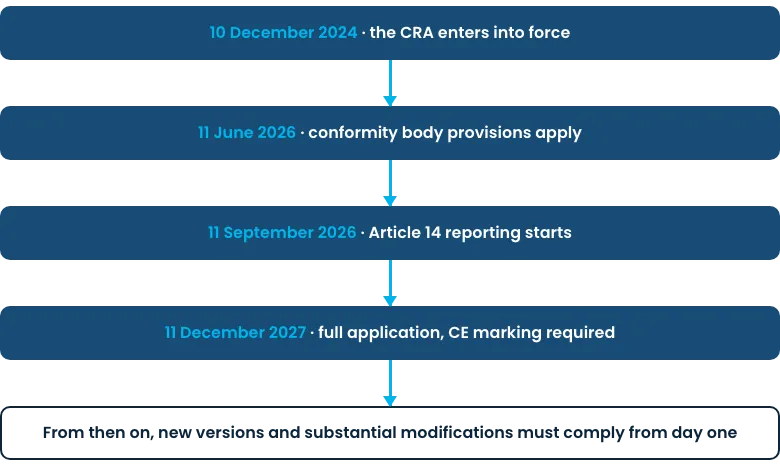
If your customers run your software themselves, the Cyber Resilience Act applies to you. Not to the hyperscalers, not primarily to IoT gadget makers: to anyone who places software on the EU market and then has to keep it secure in environments they don’t control. The regulation entered into force on December 10, 2024. The first hard obligations start on September 11, 2026, and the full regime applies from December 11, 2027. That sounds far away. It is not, because the hardest requirements are engineering work, not paperwork.
This post is the overview: who is in scope, what the deadlines are, what a manufacturer actually has to do, and in what order to do it.
Who is affected
The CRA applies to “products with digital elements” made available on the EU market in the course of a commercial activity. Where your company is headquartered does not matter. A US or UK vendor selling into the EU is covered exactly like a vendor in Berlin.
“Product with digital elements” is broad. It covers standalone software, so a self-hosted edition of your product is in scope. So is the on-prem agent you ship alongside your SaaS, the installer, the desktop client, and the SDK you give customers to integrate against.
Who is out:
- Pure SaaS. Software provided only as a service is not placed on the market as a product. Depending on your sector and size, NIS2 or DORA may apply to the service instead, but neither does so automatically. There is one catch: a “remote data processing solution” that a product needs to perform one of its functions is pulled into scope with the product (Article 3(1)-(2)). A cloud backend that your shipped agent cannot work without is that case.
- Internal software. Anything you build and run for yourself and never supply to others is not placed on the market. Bespoke software supplied commercially to a customer is in scope, though.
- Non-commercial open source. Open-source software supplied outside a commercial activity is out. Open-core companies sit in a split position: full obligations for the paid edition, a light “steward” regime for the community edition. The details are in our post on what the CRA means for open-source companies.
- Excluded sectors. Medical device software (regulated under MDR/IVDR), vehicles, aviation, and products built for defense or national security follow their own rules.
If you are unsure which side of the line you are on, work through our decision tree post. For most B2B software vendors with a self-hosted offering, the answer is simply yes.
The three deadlines
| Date | What starts |
|---|---|
| June 11, 2026 | Provisions on conformity assessment bodies apply (already in effect) |
| September 11, 2026 | Article 14 reporting: 24-hour early warning to your CSIRT and ENISA for actively exploited vulnerabilities, fuller notification within 72 hours, final report 14 days after a patch is available |
| December 11, 2027 | Full application: essential requirements, technical documentation, conformity assessment, CE marking |
One transitional rule matters a lot for existing products. Products placed on the market before December 11, 2027 only need full compliance after a substantial modification. But Article 14 reporting applies to them anyway from September 2026. You cannot grandfather your way out of the 24-hour clock.
What a manufacturer has to do
The duties split cleanly into what must be true before you place a product on the market and what you owe for as long as you support it.
Before market
| Duty | Where |
|---|---|
| Cybersecurity risk assessment, documented and kept current | Article 13 |
| Secure-by-design essential requirements | Annex I Part I |
| No known exploitable vulnerabilities at release | Annex I Part I |
| Machine-readable SBOM covering at least top-level dependencies | Annex I Part II (1) |
| Conformity assessment appropriate to the product class | Articles 27, 32 |
| Technical documentation, including a description of your secure update distribution | Annex VII |
| EU declaration of conformity and CE marking | Articles 28, 30 |
The conformity route depends on classification. The default category, which covers most business software, self-assesses under Module A. “Important” products in Annex III Class I (identity and access management, password managers, VPNs, network management systems, SIEM, operating systems, and similar) can self-assess only if they fully apply harmonised standards, common specifications, or an EU cybersecurity certification scheme at assurance level “substantial” (Article 32(2)); the harmonised standards are still being finalized, so in practice a notified body often gets involved. Class II (hypervisors, container runtimes, firewalls, intrusion detection and prevention systems) requires third-party assessment. Critical products in Annex IV, such as smart meter gateways, smartcards and secure elements, and hardware devices with security boxes, may face mandatory EU certification.
Ongoing, for the whole support period
| Duty | Where |
|---|---|
| Vulnerability handling, including a coordinated vulnerability disclosure policy and a contact address | Annex I Part II (4), (5), (6) |
| Remediate vulnerabilities without delay; ship security updates separately from feature updates where technically feasible | Annex I Part II (2) |
| Secure mechanism to distribute updates | Annex I Part II (7) |
| Disseminate security updates without delay, free of charge (unless agreed otherwise with a business user for a tailor-made product), with advisory messages | Annex I Part II (8) |
| Support period of at least 5 years | Article 13(8) |
| Keep each security update available for at least 10 years | Article 13(9) |
| Report actively exploited vulnerabilities and severe incidents | Article 14 |
For a SaaS company the ongoing list is mostly a deploy pipeline. For a vendor with self-hosted customers it is a distribution problem, and for customers without internet access it is a hard one. We cover that in detail in security updates for on-prem and air-gapped customers.
The order of operations for a vendor starting now
- Write the scope memo. One document that lists every artifact you supply commercially (editions, agents, installers, SDKs), says which are products under the CRA, and names the manufacturer entity. Every later decision references this memo.
- Classify each product. Default, Class I, Class II, or critical. This decides whether you can self-assess and therefore how much lead time you need. Most B2B software lands in the default category, but check Annex III honestly: “network management” and “identity management” catch more products than vendors expect.
- Stand up the SBOM and the CVD policy. The SBOM must be machine-readable and generated per release, not once. The CVD policy needs a published contact and an internal process behind it. Both are prerequisites for everything downstream.
- Fix update distribution. An authenticated channel, signed artifacts, security releases separated from feature releases, an advisory process, and an offline path if you have air-gapped customers. This is the item with the longest engineering tail, so start it early.
- Get reporting-ready before September 11, 2026. A runbook that gets you from “we learned of active exploitation” to a submitted early warning in under 24 hours, including who is on call and how you identify affected customers.
- Assemble the technical file and CE marking before December 11, 2027. Annex VII documentation, the declaration of conformity, and the marking itself. If steps 1 through 5 are done, this step is mostly writing down what already exists.
Penalties
Non-compliance with the essential requirements or the core manufacturer obligations can cost up to EUR 15 million or 2.5% of worldwide annual turnover, whichever is higher. Other obligations top out at EUR 10 million or 2%, and supplying misleading information to authorities at EUR 5 million or 1%. Market surveillance authorities can also order corrective action, restrict availability, or force a withdrawal or recall. For most vendors the recall power is the scarier one: fines are negotiable, a product pulled from the EU market is not.


