
Delivering Security Updates to On-Prem and Air-Gapped Customers Under the CRA
What the Cyber Resilience Act requires for secure update distribution to self-hosted and air-gapped customers: signed artifacts, advisory messages, delivery evidence, and offline update patterns.
Last verified: July 2026. Based on Regulation (EU) 2024/2847 and the European Commission’s March 2026 draft guidance. The draft guidance can still change.
The Cyber Resilience Act has a requirement that gets almost no attention next to SBOMs and CE marking, and it happens to be the hardest one for vendors with self-hosted customers. Annex I, Part II, point (7) requires manufacturers to “provide for mechanisms to securely distribute updates for products with digital elements to ensure that vulnerabilities are fixed or mitigated in a timely manner and, where applicable for security updates, in an automatic manner.” Point (8) adds that security updates must be disseminated “without delay” and, unless agreed otherwise with a business user for a tailor-made product, free of charge, “accompanied by advisory messages providing users with the relevant information.”
If all your customers run your SaaS, this is a deploy pipeline. If your customers run your software themselves, behind their firewalls, sometimes with no internet access at all, this is a distribution problem. And you have to describe your solution in writing: Annex VII requires the technical documentation to include “a description of the technical solutions chosen for the secure distribution of updates.”
What the CRA actually requires (and what it doesn’t)
Four obligations shape the update pipeline for a self-hosted product:
| Obligation | Where | What it means in practice |
|---|---|---|
| Secure distribution mechanism | Annex I Part II (7) | An authenticated, integrity-protected way for every customer to get updates |
| Dissemination without delay, with advisories | Annex I Part II (8) | You notify customers when a security update exists and tell them what to do |
| Security updates separate from feature updates | Annex I Part II (2) | Customers can take the patch without taking the new features, where technically feasible |
| Updates stay available for 10 years | Article 13(9) | Every security update remains downloadable for 10 years or the rest of the support period, whichever is longer |
Just as important is what the CRA does not require. It does not mandate that your product phones home. It does not require automatic updates for B2B software: the automatic-update default in Annex I Part I is aimed at consumer products, and Recital 56 explicitly carves out products intended for professional ICT and industrial environments, where operators control change windows. And it does not prescribe a technical architecture. A signed tarball on an authenticated download portal can be compliant. The bar is that the mechanism is secure, documented, and actually reaches every customer during the support period of at least five years (Article 13(8)).
That last part is where air-gapped customers come in. “Our updater needs internet access” is not an answer the CRA accepts, because the obligation is yours, not your customer’s.
The patch flow, end to end
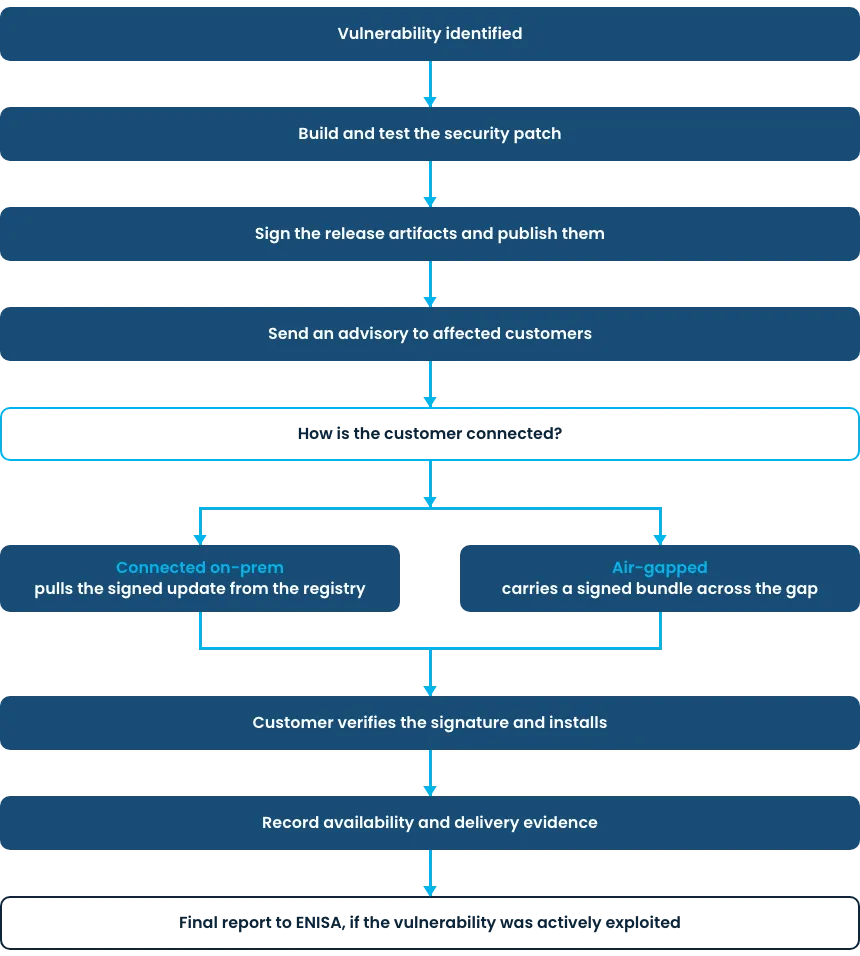
Two boxes in that chart do most of the compliance work and most vendors have neither: the advisory message and the delivery evidence.
Pattern 1: connected on-prem customers
Customers with outbound internet access are the easy case. The workable pattern:
- Distribute through an authenticated artifact channel. A private OCI registry, a package repository, or a download portal with per-customer credentials. Public “latest.zip” links fail the secure-distribution test and give you no idea who received what.
- Sign your artifacts and publish the verification path. Cosign signatures on container images, GPG on packages, or a TUF-style metadata layer. Annex VII makes you describe this anyway; it is easier to describe something real.
- Tag security releases as security releases. The separation requirement in Annex I Part II (2) means a customer on 2.3 should be able to get 2.3.1 with the fix without being forced onto 3.0. Practically, that means maintaining patch branches for supported versions, which is why the support-period decision (5 years minimum) belongs in engineering planning, not just legal review.
- Consider deployment agents for managed rollouts. A lightweight agent in the customer environment that pulls the desired version, applies it inside the customer’s change window, and reports the deployed version back closes the loop that a registry alone leaves open: you know not just who downloaded the patch but who is running it. For B2B this stays customer-controlled, which is exactly what Recital 56 expects for professional environments.
- Keep pull records. When a market surveillance authority, or more likely a NIS2-regulated customer’s auditor, asks whether the patch reached your customers, “here is the download log per customer, per version, with timestamps” ends the conversation. A registry that keeps pull audit logs gives you this as a byproduct of normal distribution.
The advisory message: the duty everyone forgets
Annex I Part II (8) does not just say ship the patch. It says security updates come “accompanied by advisory messages providing users with the relevant information, including on potential action to be taken.” That is a notification duty, and it needs to work for every customer, not just the ones who read your changelog. A pattern that satisfies it without heroics:
- A structured advisory per security release: affected versions, severity, the fixed version, and what the operator should do. Attach it to the release itself so it travels with the artifact, and publish it on a page or feed a security team can subscribe to.
- A push channel for the customers you can reach: automated email to the registered security contact per customer, or a notice in the portal your customers already use for downloads. Manual bcc-emails from support break down at exactly the moment they matter, during an incident.
- A pull channel for everyone else: a security advisories page or RSS feed with stable URLs, because air-gapped operators and procurement auditors will both ask for it.
- Precision about versions. “Please update to the latest version” is not an advisory. “CVE-X affects 2.1.0 through 2.3.4, fixed in 2.3.5 and 3.1.2” lets an operator act in minutes and is the wording Annex I Part II (4) expects for public disclosure anyway.
Pattern 2: air-gapped customers
For environments with no internet access, the mechanism changes but the obligations don’t. The pattern that holds up:
- Build an offline bundle per release: all images, charts, packages, and dependencies a customer needs, so nothing has to be resolved online inside the gap.
- Sign the bundle and ship detached verification material. The customer must be able to verify authenticity on their side of the gap with keys or certificates they received through a separate, earlier channel. A checksum alone detects corruption, not tampering.
- Document the transfer workflow the customer uses: approved media, scanning on both sides, an internal registry or mirror inside the gap that their deployments pull from. You don’t control this part, but your Annex VII documentation should describe the handoff point and the verification steps.
- Deliver the advisory out of band. The air-gapped system won’t tell its operators a patch exists. Your advisory email, customer portal notice, or RSS/security feed is the mechanism, so it needs to name the affected versions precisely enough that an operator can check theirs.
- Record what you made available and when. Inside the gap you cannot prove installation. You can prove availability, notification, and handover. Under Annex I Part II your duty is to distribute and disseminate; if a business customer contractually controls installation windows, document that split of responsibility and you have done your part.
The uncomfortable question: who is still running the vulnerable version?
The reporting obligations that start on September 11, 2026 put a clock on all of this. An actively exploited vulnerability means an early warning to your CSIRT and ENISA within 24 hours, a fuller notification within 72, and a final report 14 days after the patch is available (Article 14). Somewhere in that window, someone will ask which customers are affected.
For SaaS that’s a database query. For a self-hosted product it depends entirely on whether your distribution setup tracks versions per customer: what each customer last pulled, what each connected deployment currently runs, which air-gapped customer received which bundle. Vendors that ship through an authenticated registry with pull tracking, or run agents that report deployed versions, can answer in minutes. Vendors that ship zip files by email answer with a spreadsheet and a guess.
Play the timeline through once and the difference stops being theoretical. At hour zero you learn CVE-X in your product is being exploited. By hour 24 your early warning is filed. By hour 72 your notification should describe corrective measures, and in parallel you must inform affected users. If per-customer version data exists, “affected users” is a filtered list and the advisory goes out the same day, to the right customers, naming their versions. If it doesn’t, you either notify everyone (and train customers to ignore your advisories) or notify nobody until support has phoned through the install base, while the 14-day final report deadline runs. The final report also asks what corrective measures were taken and how users were informed, which is hard to write truthfully if the honest answer is “we don’t know who got the patch.”
The version question also decides what your patch costs. Knowing that 80% of customers already run the fixed line and exactly six deployments sit on the vulnerable 2.1 branch turns a fleet-wide fire drill into six phone calls. Neither the CRA nor anyone else audits the guess today; your customers’ security teams will, and from December 2027 the technical file has to describe the mechanism either way.


