
Does the Cyber Resilience Act Apply to Your Company? A Decision Tree
A practical decision tree for the EU Cyber Resilience Act: SaaS vs self-hosted, agents, open source, internal tools, and non-EU vendors, with worked examples and product classification.
Last verified: July 2026. Based on Regulation (EU) 2024/2847 and the European Commission’s March 2026 draft guidance. The draft guidance can still change.
Most CRA scoping questions come down to one distinction the regulation makes and most summaries blur: the CRA regulates products, not companies. Your company is not “in scope” or “out of scope.” Each artifact you supply is. A SaaS company can be entirely out of scope for its hosted service and fully in scope for the agent it asks customers to install. Work through the tree per artifact and the answer usually stops being controversial.
The decision tree
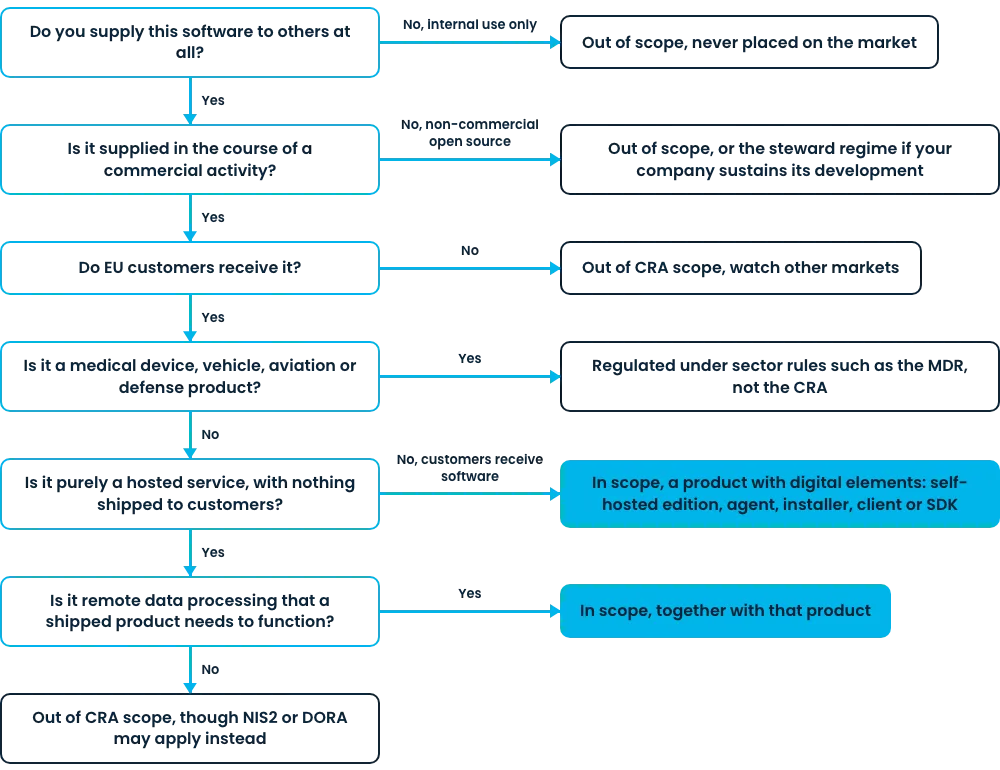
The tree asks, in order:
- Do you supply this software to others at all? If it is for internal use only, it is out of scope, because it is never placed on the market.
- Is it supplied in the course of a commercial activity? If not, as with non-commercial open source, it is out of scope, or under the steward regime if your company sustains its development.
- Do EU customers receive it? If not, it is out of CRA scope, but watch other markets.
- Is it a medical device, vehicle, aviation or defense product? If so, it is regulated under sector rules such as the MDR, not the CRA.
- Is it purely a hosted service, with nothing shipped to customers? If customers receive software, be it a self-hosted edition, an agent, an installer, a client or an SDK, it is in scope as a product with digital elements.
- Is that hosted service remote data processing a shipped product needs to function? If so, it is in scope together with that product. If not, it is out of CRA scope, though NIS2 or DORA may apply instead.
Two clarifications on the branches people get wrong.
The commercial activity test is about monetization, not the license. Selling licenses, selling support, dual licensing, or a paid hosted version all count. Developing in public does not, and neither do donations accepted without profit intent. Open-core companies land in a split position: full manufacturer obligations for the paid edition, a light steward regime for the community edition, which the March 2026 draft Commission guidance (¶49-50) treats as a separate product. That guidance is a draft and can change. Details in our post on open-source companies.
Pure SaaS is out, but “pure” is doing real work in that sentence. The moment you ship anything for the customer to run, that thing is a product. And the exception cuts the other way too: Article 3(1)-(2) pulls a hosted service into scope as a “remote data processing solution” when a shipped product needs it to perform a function. An agent that is useless without your cloud backend drags the relevant backend functionality in with it.
Worked examples
| Company | CRA status |
|---|---|
| Pure SaaS CRM, browser only, nothing installed | Out of scope. NIS2 or DORA may apply instead |
| SaaS monitoring vendor with an on-prem collector agent | The SaaS is out, the agent is a product in scope, and backend functions the agent requires come with it |
| Self-hosted database vendor, customers run it themselves | In scope, full manufacturer obligations |
| US devtools company selling licenses to EU customers | In scope. Manufacturer location is irrelevant, placing on the EU market is the trigger |
| Internal platform team building tools for its own company | Out of scope, nothing is placed on the market |
| Open-core vendor with free and paid editions | Split: manufacturer for the paid edition, likely open-source software steward for the community edition |
| Software that is part of a medical device | Out of the CRA, regulated under MDR/IVDR instead |
If you are in scope: which class?
Being in scope is question one. Question two is the classification, because it decides your conformity assessment route.
The default category covers most business software and self-assesses under Module A, without a notified body or certification, as long as the technical file holds up.
“Important” products in Annex III Class I include identity and access management systems, privileged access management, password managers, browsers, anti-malware, VPNs, network management systems, SIEM, boot managers, PKI software, operating systems, and routers. Class I products can self-assess only if they fully apply harmonised standards, common specifications, or an EU cybersecurity certification scheme at assurance level “substantial” (Article 32(2)). The harmonised standards are still being finalized, so until they land, Class I practically means involving a notified body.
Class II covers hypervisors, container runtimes, firewalls, intrusion detection and prevention systems, and tamper-resistant microprocessors. Third-party assessment, no self-assessment option. Critical products in Annex IV, such as hardware security modules and smart meter gateways, may face mandatory EU certification.
Read Annex III against what your product does, not what your marketing calls it. A “developer platform” that manages credentials and access is an identity product for classification purposes.
Can you avoid the CRA?
Three routes come up in every scoping discussion. Two are real options with a price attached, one is not an option at all.
Staying SaaS-only avoids the manufacturer obligations, because nothing is placed on the market. It does not remove EU security regulation from your life: your regulated customers carry NIS2 supply chain duties and pass them down through vendor questionnaires and contract clauses. You trade one clear product standard for many inconsistent contractual ones.
Dropping the self-hosted edition also works, and it costs you the customers who need self-hosting: banks, public sector, healthcare, anyone with data residency requirements or air-gapped networks, which are usually the largest contracts on the price list. If you consider this route, price it as lost enterprise revenue against a one-time compliance effort, not as a free simplification.
Relabeling the product does not work. A “beta,” “preview,” or “community build” that customers pay for, or that delivers a paid service, is made available in the course of a commercial activity and is on the market. Labels do not move the line.


