
Kubernetes Controller Security
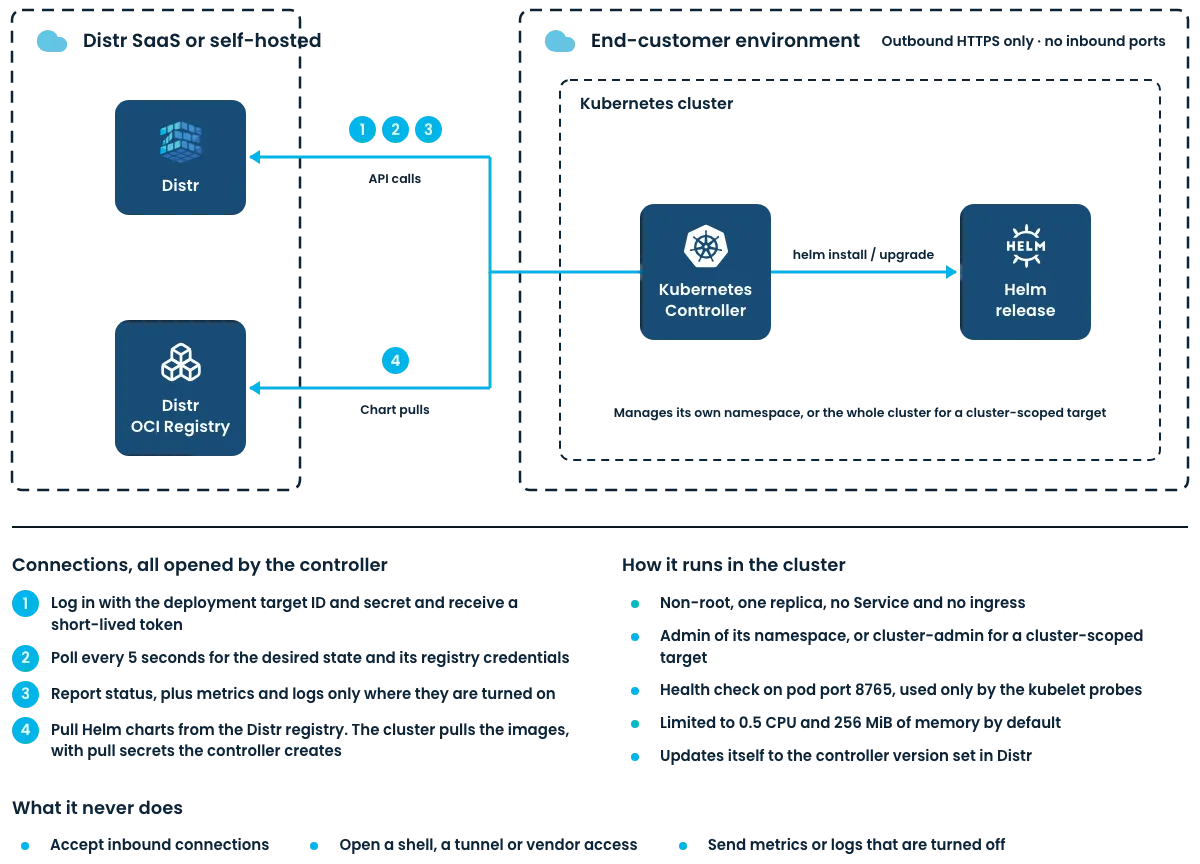
The Kubernetes controller manages Helm releases through the Kubernetes API, so it has the access of its service account.
Architecture
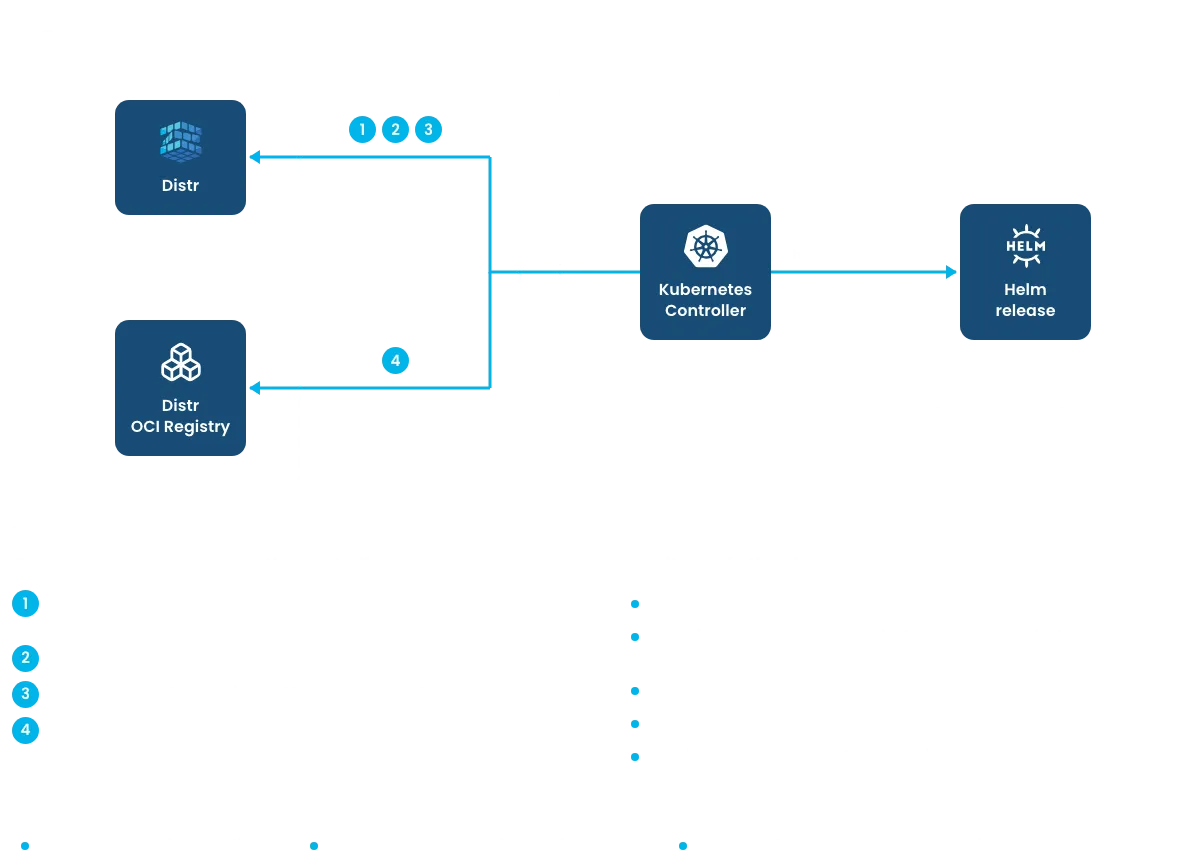
Section titled “Architecture”The controller opens every connection to Distr itself, over HTTPS, so the cluster needs no inbound ports.
Access to the Cluster
Section titled “Access to the Cluster”The manifest that installs the controller creates these resources in the namespace it is applied to:
| Resource (default) | Purpose | Optional | Changed by |
|---|---|---|---|
distr-controller ServiceAccount, bound to cluster-admin with cluster scope or to the namespace-admin Role with namespace scope | Install the resources of Helm charts and read their status, logs and metrics | No | Deployment target editor, when creating the deployment target |
distr-controller Deployment, one replica as non-root user with 256Mi memory and a CPU limit of 500m | Run the controller | No | Deployment target editor, with custom resource requirements |
distr-controller-auth Secret | Hold the target secret | No | Deployment target editor, by reconnecting |
distr-controller-env ConfigMap | Hold the Distr endpoints and the controller version | No | Not configurable |
distr-controller-dockerconfig Secret | Provide the registry credentials the Distr instance configures for all controllers | Yes, only with CONTROLLER_DOCKER_CONFIG set on a self-hosted Distr | Distr administrator |
emptyDir cache volume | Keep the pulled Helm charts | No | Not configurable |
A deployment target editor is a user with the read_write or admin role in the vendor organization or in the customer organization the deployment target belongs to. The scope cannot be changed after the deployment target is created. The namespace-admin Role grants every verb on every resource of the namespace, including Secrets, Roles and RoleBindings. cluster-admin grants the same on every resource of the cluster, which metrics need to read the nodes.
Distr renders the manifest when the controller connects and again for every self-update. A change to the custom resource requirements reaches the cluster with the next reconnect or controller update.
Kubernetes Operations
Section titled “Kubernetes Operations”| When | What the controller does |
|---|---|
| A deployment is created or updated | Writes the image pull secret sh.distr.agent.v1.<release>.pull, adds it to every imagePullSecrets and pullSecrets list in the values and runs helm install or helm upgrade in its namespace. By default Helm waits for the resources to become ready and rolls back on failure, unless the Helm options of the deployment say otherwise |
| A deployment is force restarted | After the upgrade, patches the workloads of the release the way kubectl rollout restart does |
| A deployment is undeployed | helm uninstall, then deletes the tracking secret sh.distr.agent.v1.<release> |
| Continuously | Reads the tracking secrets and Helm releases of its namespace and the status of the release resources. With log collection enabled it reads the logs of their pods, with metrics enabled the pods and pod metrics of its namespace and the nodes and node metrics of the cluster |
| The controller version changes | Fetches the new manifest from Distr and creates or updates its resources, including its own role binding |
Anything the chart of a deployment defines runs as well, such as Helm hooks. Releases are installed in the controller’s namespace, but with cluster scope a chart can create resources anywhere in the cluster.
Credentials in the Cluster
Section titled “Credentials in the Cluster”- The
distr-controller-authSecret holds the target secret. Authentication explains how to replace it. - The image pull secret of every deployment holds its registry credentials. Registry credentials are also kept in the temporary directory of the controller container.
- Helm stores every revision of a release, including its values with their secrets filled in, in Secrets named
sh.helm.release.v1.<release>.v<revision>.
Anyone who can read Secrets in the controller’s namespace can read all of these.