
Choosing the Right Software Deployment Model: Self-Hosted, SaaS, or BYOC


Software vendors and customers have to navigate a confusing landscape of deployment models and target environments. In this piece we untangle the differences between SaaS, BYOC, and self-hosted deployments.
Anyone who’s ever had to research and source technical B2B tooling is well-used to deciphering the pricing sections of product websites. These pages are filled with recurring terms like SaaS, BYOC, and Self-Hosted. I’ve found myself scratching my head trying to make sense of how they all fit together. Companies use the same terms slightly differently, there’s no standardized definition for most of them, and some overlap or get used interchangeably.
For example, “On-Premises” and “Self-Hosted” sound similar, but they don’t mean the exact same thing. And “self-hosted” itself goes by another name: many commercial vendors call the same model “self-managed” (GitLab Self-Managed being the best-known example). As software vendors deploy to increasingly regulated and complex environments, it’s worth getting some clarity on what these terms actually mean and when they should be used.
Deployment methods and deployment targets
I’ll admit upfront, this blog post includes a few opinionated takes. Since there’s no official authority defining how industry terms should be used, I’m calling things as I see them. My first take? It makes the most sense to distinguish between deployment methods (or models) and deployment target environments. I’ll explain why below.
We’ll use the following terms throughout the article, so here’s what I mean by each:
- Software vendor: A company that creates a software product and provides it to customers who use it within their own operations.
- Software customer: A company that has a contractual agreement to purchase and use a vendor’s software.
- Infrastructure management: Configuring, maintaining, troubleshooting, and provisioning the infrastructure on which a given piece of software runs.
- Infrastructure ownership: The entity that owns the infrastructure itself. Ownership is distinct from management; in some cases, customer-owned infrastructure is managed by the vendor.
- Deployment method/model: How software gets deployed, defined by how responsibility for infrastructure management and ownership is split between vendor and customer. Compliance, security concerns, and customer preferences drive the choice.
- Deployment target: The physical environment where vendor-supplied software will run. This is about infrastructure characteristics, not about who is responsible for what.
Deployment methods
The confusion I run into most often is that deployment methods get mistaken for deployment target environments. These are the three main methods.
Fully managed (SaaS)
This model transfers all operational and security responsibilities to the vendor, who owns and manages both the software and the infrastructure it runs on. Customers typically access the software through a subscription fee. There’s little confusion around roles since the vendor handles nearly everything.
SaaS offerings appeal to customers who want to start using the software quickly without dedicating time or resources to ongoing maintenance.
Who is the target user for SaaS offerings?
Companies of all sizes that prioritize ease and flexibility over data sovereignty. These customers may not have strict compliance requirements and are comfortable with a model where they don’t control availability, configurations, versioning, or security.
Bring your own Cloud (BYOC)
BYOC has emerged over the last few years as a middle path, particularly attractive to companies in highly regulated industries with strict requirements for data sovereignty, access, and security. In the BYOC model, the vendor is granted access to a VPC within the customer’s environment. The vendor manages the software and infrastructure there, but with permissions usually restricted to workload-specific needs. A zero-trust security model often complements BYOC so that no data ever leaves the VPC and the customer can cut the vendor off at any time.
This shared responsibility for infrastructure and support brings its own challenges for both sides. But for companies that lack the resources to fully self-host and can’t onboard a third-party SaaS, BYOC fills the gap.
What should you look for in a mature BYOC offering?
Granular permissions on who can access and modify data within the BYOC environment, solid monitoring and logging to track usage and potential security incidents, clearly defined SLAs covering uptime guarantees and support response times, and access to technical support people who actually know the product.
Who is the target user for the BYOC model?
BYOC is usually adopted by large enterprises in highly regulated industries, such as finance, healthcare, and government, that might not have a sophisticated infrastructure management team of their own. Their compliance and data sovereignty requirements rule out traditional SaaS, but they still want the convenience and expertise of vendor-managed operations inside their own infrastructure.
There’s also a strong case for users who may not have the strictest compliance requirements but have invested in bulk cloud resources at a discounted rate. Many companies purchase reserved instances or commit to bulk cloud usage for preferential pricing, and BYOC lets them put those resources to work.
Note: The elephant in the BYOC room is that, while some companies appreciate the convenience of having their infrastructure managed by a software provider (even within an isolated Kubernetes cluster or a dedicated set of VMs), many others will never be comfortable granting infrastructure management permissions or allowing a vendor any level of access to push software into their environments. That makes BYOC a non-viable option for many.
Self-hosted
Companies choosing self-hosted deployment are usually driven by a desire to fully own their environments, whether for compliance, security, or operational efficiency.
In this model, the customer takes on full responsibility for both infrastructure and software maintenance. The vendor issues a license, and from there, the customer handles everything else: installation, updates, scaling, backups. It fits organizations that want to keep all data and operations under their control, and it also suits those with reserved compute or discounted cloud resources they want to put to full use.
Who is the target user for self-hosted?
The self-hosted model suits companies that value total control over their software and infrastructure, whether for compliance, security, or cost-efficiency reasons. These organizations typically have the internal resources for maintenance and prefer to keep their environment fully private, whether in the cloud or on-prem.
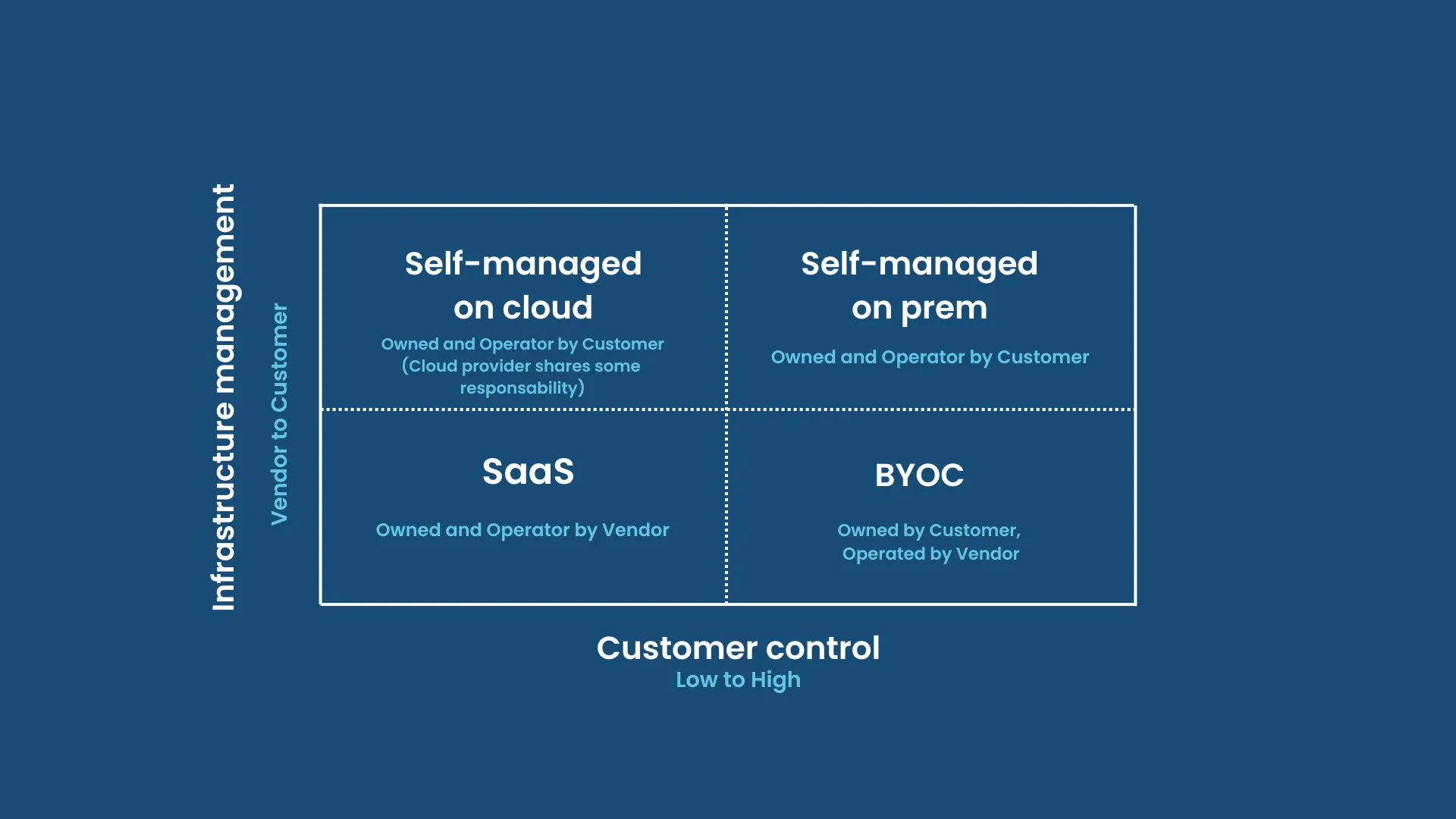
Here’s a deployment model quadrant that organizes the relationship between customer control and infrastructure management, essentially the balancing act needed to determine the most suitable deployment method for a given use case.
Deployment target environments
Unlike deployment methods, target environments are about the physical attributes of the space where the software operates. These characteristics vary widely (size, fault tolerance, resilience), but from a deployment perspective, the key factor is who owns the infrastructure.
Vendor owned infrastructure
This one is straightforward: if the software vendor hosts the product and provides access via a subscription or payment plan, we’re talking about SaaS.
There’s little ambiguity here because, as the creator and manager of the software and its underlying infrastructure, the vendor takes on full responsibility. SaaS works well for both sides: users get convenience, vendors get economies of scale, centralized monitoring, and full control over infrastructure management.
This model isn’t ideal, though, for companies with strict compliance or data sovereignty requirements, or for those with existing hardware commitments they want to get the most from.
Customer owned infrastructure
Customer-owned infrastructure comes in a few flavors.
Cloud hyperscalers
Customers can run software in their own AWS, Azure, or GCP accounts. The hyperscalers give them access to managed services, preferential pricing through usage commitments, and global networks that would be prohibitively expensive for most companies to build themselves.
Hybrid and multi-cloud environments
To avoid locking into a single provider, many organizations mix services from multiple clouds, or combine cloud resources with their own data centers. This gives customers more freedom to choose the services, pricing, and terms that suit them best, though some ownership and responsibility always remains with each cloud provider.
On-premises environments and data centers
Some software customers deploy to privately owned data centers. This is the most cumbersome, costly, and labor-intensive option, but it offers the highest level of flexibility and privacy, and for air-gapped environments it’s the only option.
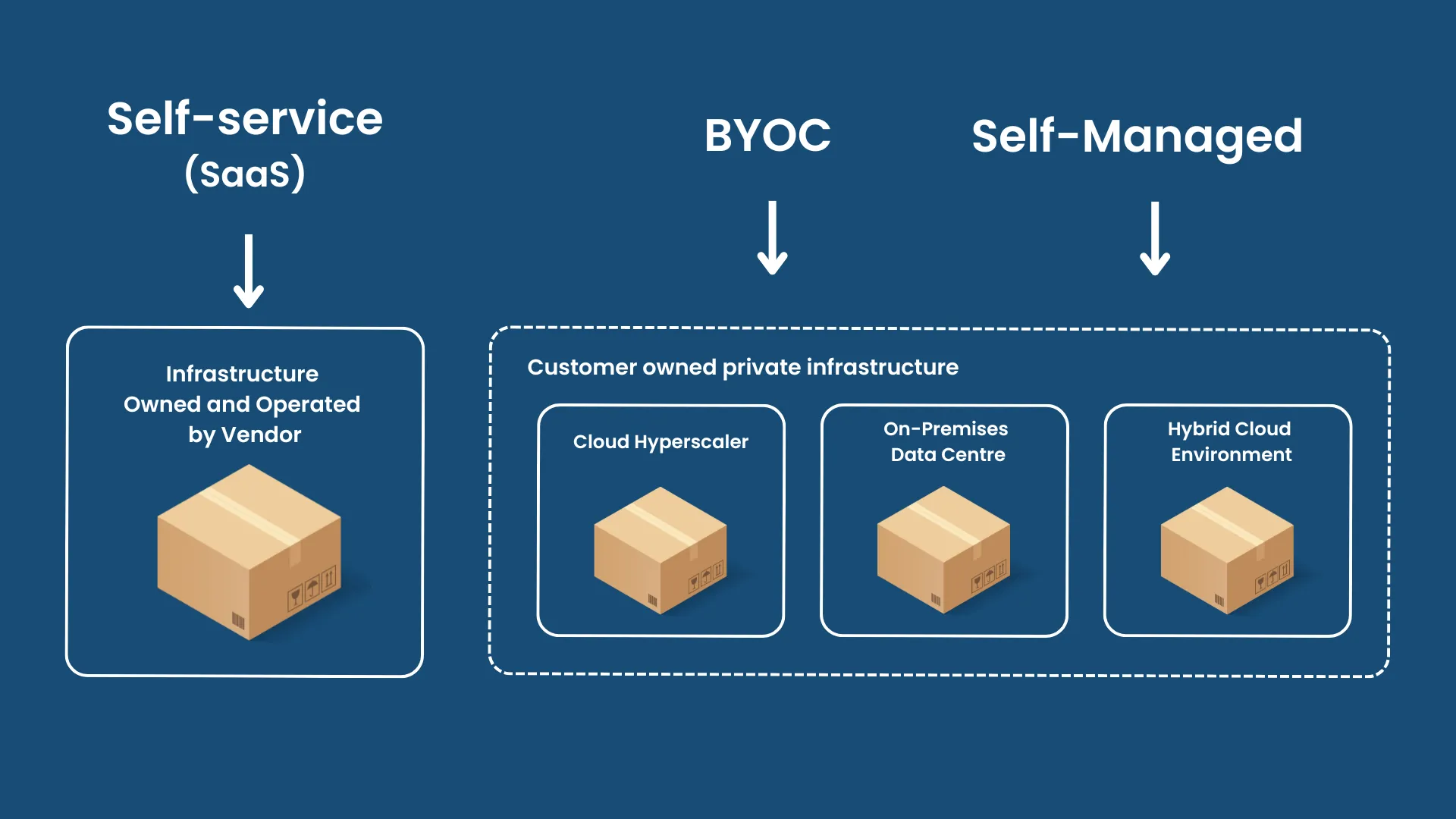
Apart from the SaaS deployment model, which is always vendor-owned and controlled, the other two models can be deployed to any target environment. It’s up to the customer to determine the appropriate environment based on their specific restrictions or requirements.
In-depth comparison of deployment models
Which deployment method is the most cost effective?
SaaS tends to be the most cost-effective option for businesses looking for minimal maintenance and predictable costs, as it bundles infrastructure, security, and updates into a subscription. BYOC can be economical for organizations that have already committed to cloud resources, letting them maximize discounts from reserved instances while sharing management with the vendor. Self-hosted is typically the most costly because of the dedicated infrastructure and ongoing maintenance it requires. That said, it can pay off for companies with strict control requirements and the internal resources to manage their own setup.
Which deployment method is the most secure?
Self-hosted provides the strongest control position for organizations with strict data and infrastructure requirements, since they manage everything internally without vendor access. BYOC offers a middle ground: customers enforce data sovereignty by keeping sensitive data within their own cloud environment while the vendor handles the software and parts of the infrastructure. SaaS is secure enough for most general cases, but it’s a harder sell in highly regulated industries where the customer’s lack of control over infrastructure is a concern in itself.
Understanding the sliding scale of shared responsibilities
In SaaS, the vendor takes on nearly all responsibilities, from security to infrastructure management, leaving the customer to manage only access. BYOC shifts some of this responsibility back to the customer, who owns and secures their cloud environment. Data stays within the customer’s domain, while the vendor manages the software and parts of the infrastructure within those boundaries.
Self-hosted places full responsibility on the customer, granting them complete control but requiring substantial internal resources. Vendors still play a big role in whether those deployments succeed, though. That means designing software to be self-hosted ready, securing the base images it’s built on, providing registries to serve those images (via proxies, or archive files for air-gapped environments), and keeping the upgrade process simple and well documented. The customer deploys and operates the software, but the vendor decides how painful that experience is.
The spectrum from SaaS to self-hosted is a trade-off between control and operational burden, with customers weighing vendor support against the autonomy they seek.
Conclusion
There’s a clear distinction between how customers choose to consume software and the environment where it runs. Some vendors prefer certain deployment models, but it’s ultimately customer requirements that dictate which options a vendor should offer. Not every customer can simply enter a credit card number and subscribe to a SaaS plan.
For vendors that haven’t built out deployment capabilities beyond SaaS, a software distribution platform like Distr covers the self-hosted and BYOC side: artifact distribution through a private registry, guided installations and updates, license enforcement, and deployment monitoring across customer environments. That way, the customers who can’t do SaaS don’t have to go unserved.


